Like cures like
The traditional “law of similars” proposes that a substance producing certain symptoms in a healthy person may be selected for someone with similar symptoms.
A closer look at a system of complementary medicine that began more than two centuries ago. Discover its origins, the ideas behind its practice, how preparations are made and what modern research tells us.

Photo: Lebemaja / Pixabay · Pixabay Content License
Homeopathy is a system of complementary medicine developed by German physician Samuel Hahnemann in the late eighteenth century. It is traditionally associated with two ideas: “like cures like” and the use of highly diluted preparations.
The word is formed from Greek roots often translated as homoios (similar) and pathos (suffering). The name reflects the system's historical principle of selecting a preparation based on a claimed similarity between symptoms.
Understanding homeopathy means looking at both its historical philosophy and the standards used today to evaluate whether a treatment is safe and effective.
The traditional “law of similars” proposes that a substance producing certain symptoms in a healthy person may be selected for someone with similar symptoms.
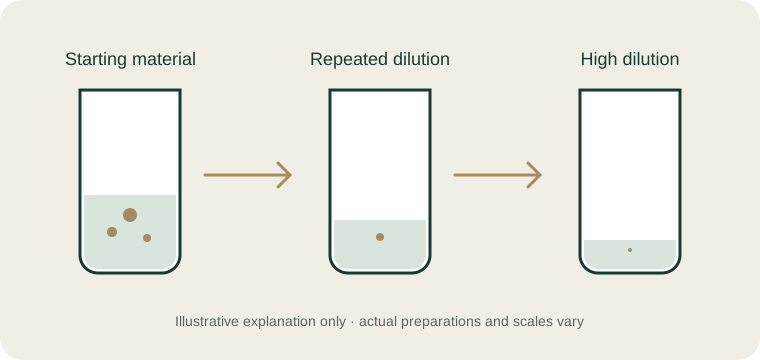
Homeopathic preparations are commonly made through repeated dilution. The traditional system proposes that smaller doses may have greater effects, an idea not established by modern pharmacology.
Traditional homeopathic consultations may consider a person's symptom description and broader history when selecting a preparation. Individualisation itself does not prove a remedy works.
The story of homeopathy is part of the wider history of medicine, publishing, education and healthcare institutions.
Samuel Hahnemann (1755–1843), a German physician and medical translator, developed the system during a period when medical practice looked very different from today. His writings introduced a new therapeutic framework that later spread through Europe and beyond.
In India, the documented story is particularly associated with John Martin Honigberger, Mahendra Lal Sircar and the early homeopathic institutions of Bengal.
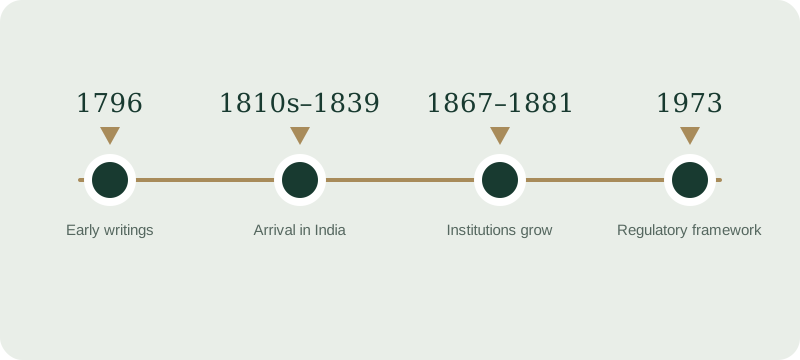
Hahnemann's reported self-experiment with cinchona bark later became a key story in the development of his ideas.
He published an essay outlining a new principle for investigating the medicinal powers of substances.
The first edition of Organon of the Rational Art of Healing was published, later known as the Organon of Medicine.
John Martin Honigberger's documented association with Punjab is widely cited in accounts of homeopathy's introduction to India.
Mahendra Lal Sircar publicly declared his conviction in homeopathy, a notable moment in its Indian history.
Sircar began publishing the Calcutta Journal of Medicine, an early journal associated with homeopathy in India.
Calcutta Homoeopathic Medical College was established, becoming an important institution in the system's Indian history.
The Central Council of Homoeopathy Act provided a statutory framework for education and professional regulation.
Historical note: Some institutional accounts mention 1810 as an early arrival date in India, while scholarly historical writing generally treats Honigberger's 1839 activity as the better-documented milestone. The exact “first arrival” date is therefore not universally agreed.
A few details that make the history of homeopathy especially interesting.
While translating a medical text by William Cullen, Hahnemann questioned the explanation for cinchona bark's use. His later self-experiment became central to the story of homeopathy's origins.
Hahnemann worked across languages and translated medical and scientific texts. His translation work helped expose him to debates about medicines and their effects.
John Martin Honigberger is associated with the court of Maharaja Ranjit Singh. Accounts of this episode became part of the documented history of homeopathy in India.
Mahendra Lal Sircar was a formally trained physician who publicly expressed his commitment to homeopathy in 1867. He also became known for promoting scientific education in India.
Calcutta Homoeopathic Medical College was established in 1881, helping create a formal educational institution for homeopathic studies in India.
April 10 is observed by homeopathic organisations as World Homoeopathy Day, marking the birth anniversary of Samuel Hahnemann.
Traditional homeopathic preparations may begin with plant, mineral or other source materials. A preparation may then undergo serial dilution and succussion, a process of vigorous shaking, according to the chosen preparation method.
Different scales are used. In the centesimal (C) scale, each step is nominally a 1:100 dilution. The figures below illustrate the arithmetic of this scale, not a recommendation or a statement of clinical effectiveness.
A 30C preparation corresponds to a nominal dilution of 1 in 10⁶⁰. At such dilutions, it is extraordinarily unlikely that a typical dose contains even one molecule of the starting material.

Homeopathic consultations are often described as individualised. A practitioner may ask about the main concern, when symptoms began, what makes them better or worse, previous diagnoses, investigations and current medicines.
Discuss symptoms, duration, severity and how they affect daily life.
Consider prior diagnoses, reports, allergies, treatments and medicines.
Review available care, evidence, limitations and whether a medical referral is needed.
Arrange follow-up where appropriate. Worsening or urgent symptoms need timely medical assessment.
Historical importance and continued use are not the same as proof that a treatment works. Modern evaluation looks at well-designed clinical trials, systematic reviews, reproducibility, safety and comparison with placebo or established care.
The U.S. National Center for Complementary and Integrative Health states that there is little evidence to support homeopathy as an effective treatment for any specific health condition. It also notes that some products labelled homeopathic may contain substantial active ingredients and can cause side effects or interactions.
Highly diluted preparations present a scientific challenge because many may contain no molecules of the original substance. No widely accepted scientific mechanism has been established to explain specific effects from these ultra-dilute preparations.
For these reasons, homeopathy should not replace evidence-based diagnosis, proven treatment, prescribed medicines or vaccination. Do not delay medical assessment or stop prescribed treatment on the basis of information on this page.
Homeopathy is a system of complementary medicine developed by Samuel Hahnemann. It is traditionally based on “like cures like” and serially diluted preparations.
Traditional homeopathic theory proposes that specially prepared remedies can produce therapeutic effects. However, no scientifically established mechanism demonstrates that highly diluted preparations treat specific diseases.
Major evidence assessments have not established reliable effectiveness for homeopathy in treating any specific health condition. The NCCIH describes the evidence as limited.
30C describes thirty successive dilution steps on the centesimal scale, with each step nominally diluting the previous preparation by 1:100.
No product should be assumed completely safe. Some products labelled homeopathic may contain active ingredients, cause side effects or interact with medicines. Product quality can also vary.
It should not replace evidence-based treatment, prescribed medicines, vaccination or necessary medical evaluation. Consult your treating doctor before changing any treatment.
Homeopathy was developed by German physician Samuel Hahnemann (1755–1843) in the late eighteenth century.
April 10 is observed as World Homoeopathy Day by homeopathic organisations, marking Hahnemann's birth anniversary.
Learn about Dr. Geetanjali's background, clinic locations and consultation process. Consultations are arranged by appointment.
The explanations on this page are original summaries. These sources are provided so readers can check the historical record, scientific assessments and product-safety guidance directly.
Regulatory statements are jurisdiction-specific. The FDA information describes the United States regulatory position and should not be read as a statement of Indian law. Historical sources may differ in their interpretation of early dates and events.